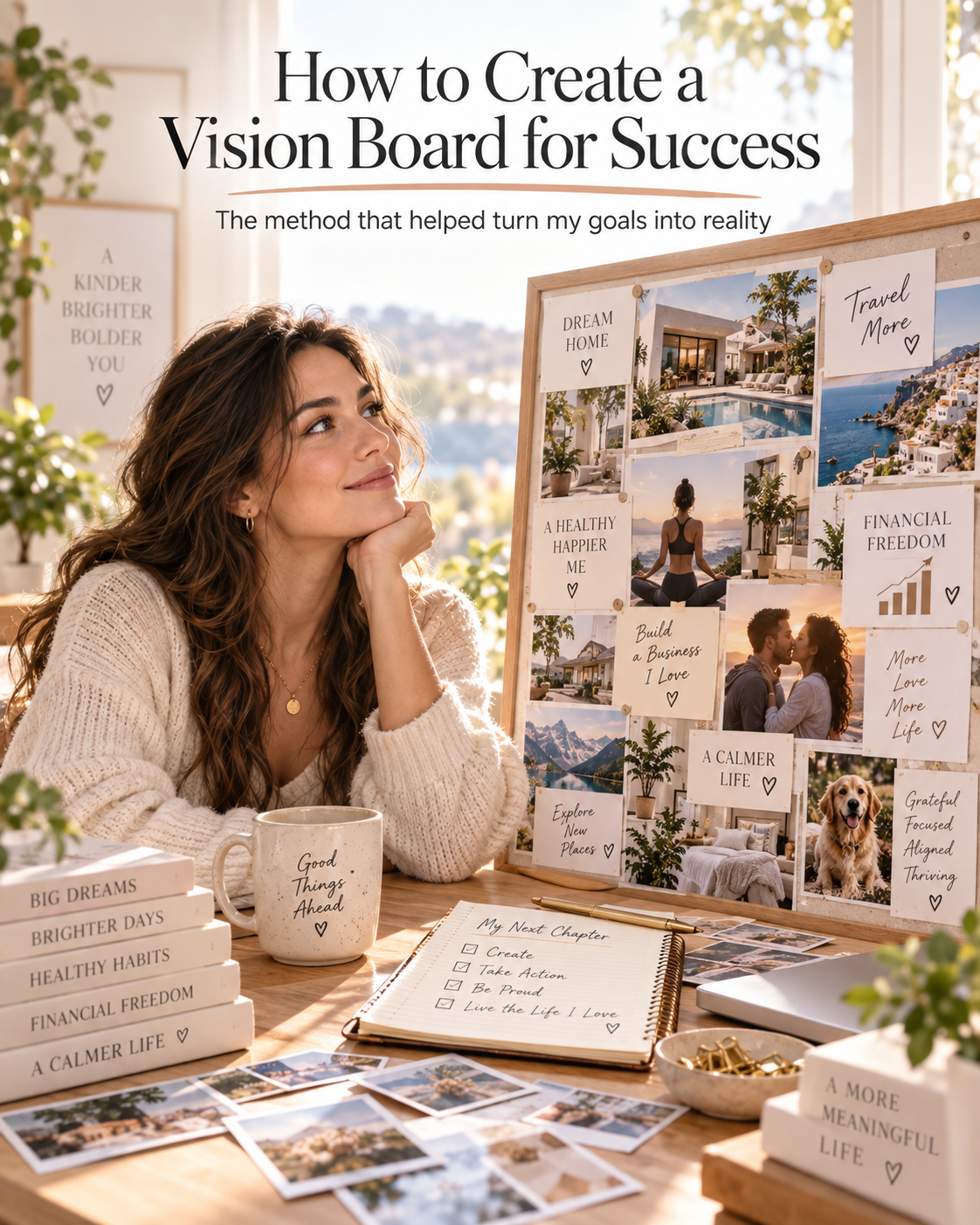

Two years ago, I created my own vision board.
At the time, it was simply a collection of pictures, words, goals, and ideas representing the life I wanted to create. Some of those goals felt completely achievable. Others seemed much further away.
Today, looking at that same board feels a little surreal.
Most of what I originally put on it has actually happened.
I say most because a few things are not completely finished yet. However, they are no longer dreams sitting on a board. They are already being built, developed, or receiving their final touches.
That experience completely changed the way I think about vision boards.
At first, you might assume a vision board is simply about manifestation. Put a picture of something you want on a board, look at it every day, and somehow it appears.
That is not what happened for me.
Instead, my vision board gave me something far more useful.
It gave me clarity.
Creating it forced me to stop and think about what I actually wanted from my life. More importantly, once those goals were right in front of me, they became much harder to ignore.
Gradually, they stopped being things I would “love to do someday.”
They became things I was actively working toward.
That is why I believe a vision board can be so powerful.
It does not create your life for you. Instead, it reminds you of the life you are trying to create.
What Is a Vision Board?
A vision board is a visual representation of your goals, dreams, and the future you want to build.
For example, it might include pictures of places you want to visit, a business you want to create, the type of home you would love to own, or a healthier lifestyle you want to achieve.
It can also represent things that cannot be purchased.
Perhaps you want more peace.
Maybe freedom matters most to you.
Confidence, love, family, health, independence, creativity, and time can all belong on a vision board too.
Some people create physical boards using photographs, magazines, notes, and printed images. Others prefer a digital version on their phone, tablet, or computer.
Ultimately, the format is not what matters.
What matters is how you feel when you look at it.
You should be able to look at your board and think:
Yes. This is the life I am working toward.
Why I Believe Vision Boards Can Work
There is nothing magical about printing a photograph of a dream house.
The real power begins with what happens afterward.
Most of us have countless goals floating around in our heads. We want to become healthier, make more money, travel, start a business, improve our relationships, buy a home, or finally pursue something we have been putting off.
Unfortunately, everyday life gets loud.
Work becomes busy. Emails pile up. Bills arrive. Children need something. Unexpected problems appear.
Before you know it, another week has passed.
Then another month disappears.
As a result, goals that once felt incredibly important slowly move into the background.
A vision board brings them back into focus.
Because you can physically see what you are working toward, your goals remain present in your mind.
Eventually, something interesting starts happening.
Instead of thinking:
“Wouldn’t it be amazing if this happened?”
you begin thinking:
“What would I actually need to do to make this happen?”
That is an important shift.
A dream is something you think about.
A goal is something you begin planning for.
What Happened With My Own Vision Board
When I created my board two years ago, I was not trying to predict my future.
I was trying to define it.
Some goals had an obvious path. In contrast, others were things I wanted even though I had absolutely no idea how I would make them happen.
Still, I put them on the board.
Over time, I also made some changes. My priorities evolved, circumstances changed, and certain goals became more important than others.
That did not make the original board unsuccessful.
Quite the opposite.
Looking at it now, what amazes me is how much of it became real.
There is something incredibly strange about seeing a picture that once represented maybe someday and suddenly realizing:
Wait. I actually did this.
Other goals are not completely finished yet. Nevertheless, they have moved far beyond the dreaming stage.
They are real projects.
They are being built.
They are almost ready.
In some cases, I am simply waiting for the final touches before I can officially say, “That one came true too.”
That experience taught me something important about success.
Progress does not always arrive as one huge, dramatic moment.
Sometimes the dream is already becoming reality while you are still busy building it.
Start With What You Actually Want
If you decide to create a vision board, do not begin by searching Pinterest for beautiful pictures.
Start with yourself.
Ask one simple question:
What do I actually want?
Surprisingly, that question can be difficult to answer.
We are constantly surrounded by other people’s definitions of success. Social media shows us the houses we should want, the vacations we should take, the bodies we should have, and the lifestyles we should admire.
Because of that, it becomes very easy to confuse what looks impressive with what would actually make us happy.
So forget everyone else for a moment.
If nobody could see your life, what would you choose?
Think about where you would live.
Consider how you would spend your days.
Imagine the work you would be doing.
Picture the people around you.
Then think about how you would feel when you woke up every morning.
Perhaps your dream is to build a huge company.
On the other hand, your perfect life might involve working fewer hours, living near the ocean, and spending more time with your family.
Neither dream is better.
Your vision board should reflect your definition of success.
Think About How You Want Your Life to Feel
One mistake people often make is focusing entirely on things.
The car.
The house.
The money.
The vacation.
The job.
Those things can absolutely belong on your board. However, it is equally important to think about the emotions behind them.
Ask yourself why you want those things.
For example, maybe you want more money because what you actually crave is security.
Perhaps you want to build a successful business because you want independence.
A beautiful home might represent stability.
Travel could represent freedom and adventure.
Better health may represent energy and confidence.
Once you understand the emotion behind the goal, your vision becomes much more personal.
For that reason, one person’s picture of financial freedom might be a bank balance.
Someone else’s might be a family sitting together on a Wednesday afternoon with nowhere they need to rush off to.
The image is different, but the feeling is the same.
Freedom.
Choose Images That Make You Feel Something
Your vision board should create an emotional reaction.
Therefore, avoid choosing pictures simply because they look beautiful.
Choose images that mean something to you.
If you want to travel to Italy, find the exact city or village you imagine yourself visiting.
Likewise, if your goal is to build a company, choose something that represents the business you actually want to create.
For better health, look beyond appearance. Find an image that represents strength, energy, confidence, or the way you want to feel.
When you see the right picture, there should be an instant connection.
You should think:
That. I want that.
Make Your Goals Specific
Inspiration is important, but specificity gives you direction.
Rather than writing:
Make more money
you could write:
Build a business generating €___ per year.
Instead of:
Travel more
name the places you actually want to visit.
Likewise, replace:
Get healthier
with a goal you can measure, such as exercising four times each week or improving your strength.
A vague dream can easily stay vague forever.
A specific goal, however, gives you something to work toward.
Put Something on Your Board That Scares You
Not every goal should feel completely realistic when you first add it.
In fact, I think at least one should make you wonder:
How am I ever going to make that happen?
You do not need to know the answer immediately.
Some things on my own vision board did not have a clear path when I added them.
Nevertheless, things began changing.
New opportunities appeared.
Connections happened.
Decisions led somewhere unexpected.
Work started accumulating.
Little by little, the path became clearer.
We often convince ourselves that we need to see the entire road before taking the first step.
Usually, we do not.
Most of the time, we simply need to know what the next step is.
Put Your Vision Board Somewhere You Can See It
Once your board is finished, do not hide it in a closet.
Visibility matters.
Place it somewhere you naturally see every day, such as your bedroom, office, desk, phone, or laptop.
You do not need to stare at it for an hour every morning.
Instead, simply allow it to become part of your environment.
When your goals remain visible, it becomes harder for everyday distractions to make you forget them.
That is one of the simplest reasons vision boards can be effective.
They keep the destination in sight.
Turn Your Vision Into Action
This is the most important part.
A vision board without action is just a collection of pictures.
So every time you look at one of your goals, ask yourself:
What is one thing I can do today that moves me closer to this?
If you want to start a business, research the market.
For a future home, calculate what you would need financially.
If travel is your goal, start researching costs.
Considering a new career? Update your CV.
Trying to improve your health? Do something today that supports that goal.
You do not need to complete the entire journey at once.
Instead, concentrate on moving forward.
Success is rarely created through one enormous decision.
More often, it comes from hundreds of smaller choices that seem almost insignificant while you are making them.
Eventually, you look back and realize those tiny decisions changed everything.
Let Your Vision Board Change With You
Your vision board is not a contract.
You are allowed to change it.
I have changed mine.
Over the past two years, my circumstances have evolved and so have my priorities.
Some goals became bigger.
Others became less important.
A few disappeared completely.
That is perfectly fine.
Sometimes you achieve something and realize you want to go even further. At other times, you discover that a goal never really belonged to you in the first place.
If that happens, remove it.
Your vision board should represent the future you genuinely want now, not a future you thought you wanted two years ago.
What Should You Put on a Vision Board?
There is no perfect formula.
However, thinking about different areas of your life can help you decide what belongs on yours.
Consider your career, business, finances, health, relationships, family, travel, home, education, creativity, confidence, and personal growth.
More importantly, think about the person you want to become.
Maybe you want to become more disciplined.
Perhaps you want to trust yourself more.
You might want to become braver, calmer, healthier, more independent, or more confident.
After all, sometimes the greatest transformation is not getting the house, business, trip, or money.
It is becoming the person capable of creating those things.
When Your Vision Board Starts Looking Like Your Life
This is the part I love most.
When you first create a vision board, everything on it feels like the future.
Then life continues.
You work.
You make decisions.
Some things fail.
Other things work.
Plans change.
New opportunities appear.
Eventually, you look at that board again.
One picture is no longer a dream because you already did it.
Another goal is currently happening.
Something else is almost complete.
Meanwhile, one dream may have changed completely but led you somewhere even better.
That is when you realize something.
The vision board did not predict your future.
It helped you define it.
Once you defined what you wanted, you started directing more of your attention toward it.
And over time, where you consistently place your attention and effort can have an incredible effect on where your life goes.
Final Thoughts
If you have never created a vision board because it sounds unrealistic or too focused on manifestation, I understand.
That is not how I see it.
For me, a vision board is about clarity.
Once you clearly understand what you want, you become better at recognizing the choices that move you toward it.
Just as importantly, you begin noticing the distractions that move you away from it.
My own vision board started as a collection of things I hoped would happen.
Two years later, most of them have.
Some are completely finished.
Others evolved.
A few are currently receiving their final touches.
Soon, I expect to look at those too and say:
That one came true.
Perhaps that is what makes creating a vision board so exciting.
Today, you may look at it and see pictures of your dreams.
Two years from now, you might look at the exact same board and realize something completely different.
You are looking at your life.


